CCaaS Platform: What It Is and How It Beats Legacy Call Centers
What a CCaaS platform is, how it differs from a traditional call center, and why more companies are moving their contact center to the cloud.

CCaaS (Contact Center as a Service) is a cloud model in which a provider hosts all the technology your customer-facing teams need: request routing, analytics, omnichannel communication and workforce scheduling. The service is delivered over the internet on a subscription basis. Instead of owning the infrastructure, you rent access to it.
It sounds simple, and in some ways it is. But it changes how a company organizes customer support, because flexible software replaces costly physical infrastructure. The main difference is this:
- Traditional call centers require a large upfront investment: servers, on-premises hardware, proprietary telephony licenses and specialized IT staff to keep it all running.
- CCaaS turns that investment into a predictable operating cost that grows or shrinks with your needs, with no procurement cycles or hardware refresh projects.
Because everything runs in the cloud, agents can work from anywhere with a browser and an internet connection, on site or remotely. According to several market studies, the sector is growing quickly for exactly this reason.
Legacy vs. cloud: where the traditional model breaks down
Traditional call centers are poorly matched to the way customers behave today. The core problem is fragmentation.
Legacy systems keep customer data on disconnected platforms: the CRM in one place, the ticketing system in another, call logs somewhere else. Agents have no single view of the customer, so every contact starts from scratch. Customers have to repeat themselves, and trust erodes fast.
The second weak point is scalability. On-premises hardware is sized for average demand, not for peaks. When volumes spike, for example during a product launch, a billing deadline or the sales season, physical infrastructure cannot flex. You either over-provision at a high cost or risk leaving customers unanswered. With a cloud contact center, capacity follows actual demand.
Then there are supervisors. With traditional tools they stay a step behind: they can only act once the customer experience has already suffered. More on this below.
Finally, cost. Running physical servers, sourcing spare hardware and retaining dedicated IT staff weighs on the budget without directly improving customer service.
Moving to CCaaS is simply the next step in modernization: just as email made the fax machine obsolete, the cloud removes the limits of systems installed on site.
Omnichannel communication: more than phone calls
Customers expect to move between SMS, chat, email and voice without repeating their request each time. A cloud contact center exists precisely to make that transition seamless.
In legacy environments, agents use separate tools for each channel: one window for email, another for chat, a third for call history. Every switch breaks concentration, lengthens handling time and increases errors. Across hundreds of contacts a day, that friction wears down both agent performance and customer satisfaction.
EagleMercury Contact Center brings voice, email, chat, SMS and WhatsApp into a single console. Agents stay in one environment, respond faster and keep full context across every channel. There are three main benefits:
- Consistent customer context: interaction history follows the conversation, whatever the channel.
- Less load on agents: one interface means fewer errors and faster resolutions.
- Real-time queue visibility: supervisors monitor and rebalance workloads across channels as demand shifts.
That last point, real-time data, is what turns omnichannel from a technical feature into a management advantage.
Boosting agent productivity with EagleMercury Elevate
EagleMercury Elevate combines business communication and contact center in a single platform, so agents have everything at hand without switching between tools.
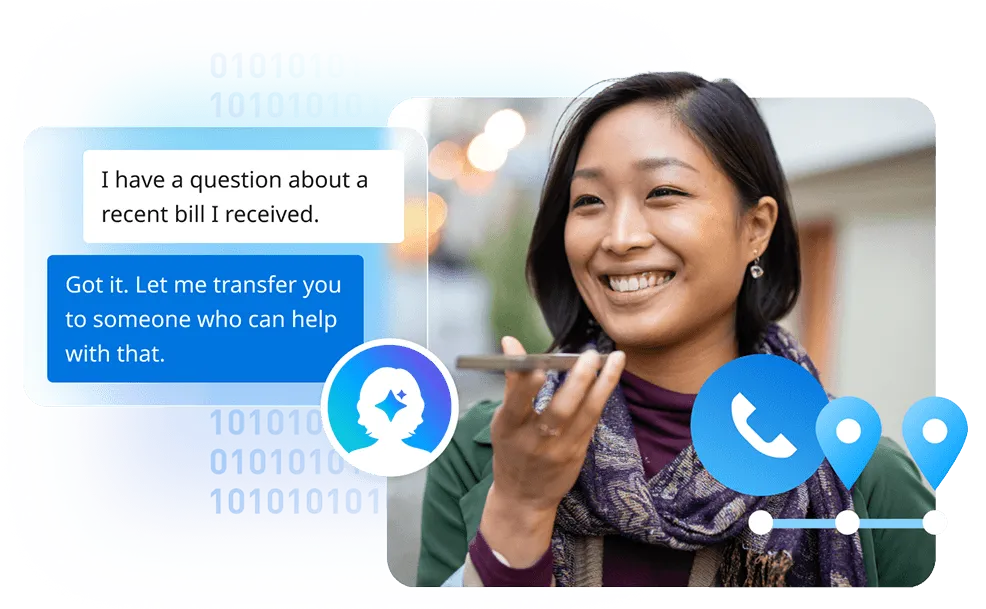
IVR and intelligent routing. Calls are directed before a person ever picks up. Instead of sending callers through generic menus, IVR with speech recognition and skills-based routing send each request to the most suitable available agent. This reduces handling time and abandoned calls.
Real-time support for supervisors. Instead of replaying recordings after the fact, supervisors use real-time dashboards and can listen in, coach and step in during a call. Sentiment analysis helps spot delicate cases as they happen, not afterwards.
AI assistant for agents. With the AI modules, agents receive suggested answers and procedures during the call. See the page on AI features for details.
Automatic summaries. When quality reviews come around, automatic call summaries cut down on note-taking and let reviewers focus on substance rather than manual work.
Internal and external communications also run on the same unified layer, so an agent never loses the thread when moving from a customer chat to a message to a colleague. The service needs no on-site hardware and comes with a 99.999% uptime SLA.
In short
- CCaaS replaces physical infrastructure and upfront investment with a flexible subscription.
- Unified data and all channels in one console remove the fragmentation of traditional systems.
- Intelligent routing, supervisor tools and AI improve quality and response times.
Want to know whether a cloud contact center fits your company? Contact us and we will show you the platform based on your channels and volumes.